
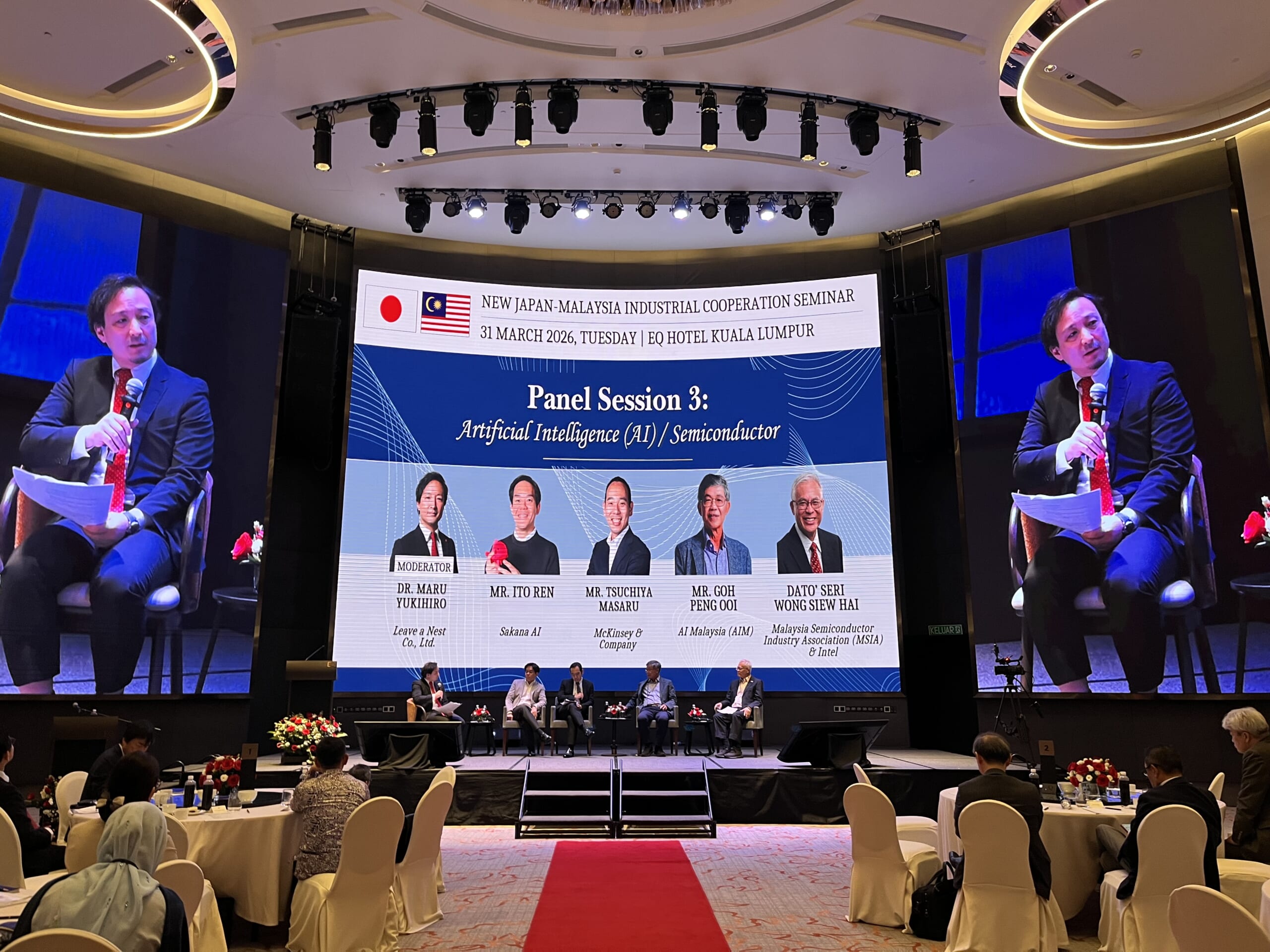
Panel session
On March 31, 2026, held in Kuala Lumpur, Malaysia, the "NewHimaru SangyocooperationAt the New Japan-Malaysia Industrial Cooperation Seminar, Leave a Nest Co., Ltd. (Head Office: Shinjuku-ku, Tokyo; Representative Director Group CEO: Yukihiko Maru) moderated the AI/Semiconductor session.
This seminar, organized by the Embassy of Japan in Malaysia and other relevant organizations, aims to further strengthen industrial cooperation between Japan and Malaysia. Specifically, it has been planned against the backdrop of the "17 Priority Areas" identified by the Japanese government as crucial from the perspectives of economic security and future industrial competitiveness in its growth strategy. The seminar is positioned as a forum to concretize Japan-Malaysia cooperation in strategic areas such as semiconductors, green transformation (GX), and AI.
In the AI/Semiconductor session moderated by Maru, the keynote speech was given by Ren Ito, co-founder of Sakana AI.and Malaysia Semiconductor Industry Association (MSIA) PresidentWelcoming Dato’ Seri Wong Siew Hai,The panel discussion that followed included the two keynote speakers, as well asMcKinsey & Company Partner, Mr. Daichi Tsuchiya, and AI Malaysia (AIM) President, Mr. Goh Peng Ooi, took the stage.
Panel session. From left: Maru Kokihiro (Representative Director, Group CEO, REALTECH HOLDINGS CO., LTD.), Ren Ito (Co-founder, Sakana AI), Dai Tsuchiya (Partner, McKinsey & Company), Goh Peng Ooi (President, AI Malaysia), Dato’ Seri Wong Siew Hai (President, Malaysia Semiconductor Industry Association)
AI shifts from "General Purpose" to "Industry-Specific" - Expansion into Agriculture
The session emphasized that the direction of AI evolution is shifting from an approach reliant on improving the performance of traditional large-scale foundation models to one where integrating the "tacit knowledge" of each industry is becoming increasingly important. It was also pointed out that the lack of connection with on-site knowledge is a reason why proof-of-concept experiments for AI adoption in many companies are not leading to results.
In the agricultural sector, in particular, initiatives were introduced that utilize AI for time-series data analysis and pattern recognition to elucidate the relationships between complex factors such as weather, soil, and growing conditions. The presentation indicated the potential to contribute to improved yield and quality not only through general weather forecasting but also through predictions of weather fluctuations optimized for specific farmlands and correlation analysis between environmental conditions and crop quality.
In this way, AI is evolving beyond the digital realm into a foundational technology that supports "understanding and decision-making in the physical world," and its integration with the primary industry is becoming an important theme in the ASEAN region.
Potential for Japan-Malaysia Cooperation in the Semiconductor Industry
In the semiconductor field, a discussion took place regarding the complementary relationship between Japan and Malaysia amid the ongoing restructuring of global supply chains. Japan possesses high competitiveness in materials, equipment, and precision technologies, while Malaysia's strengths lie in its production base, particularly in backend processes (assembly and testing). It is believed that there is significant potential for value creation through collaboration between the two countries.
Furthermore, it was recognized that the surging demand for semiconductors due to the advancement of AI requires not only
Energy challenges in the AI era and expectations for nuclear fusion
Furthermore, the panel also touched upon the issue of "energy," which is closely related to the widespread adoption of AI. It was pointed out that as AI becomes more advanced, the demand for computational resources increases, and it may not be possible to offset the rise in consumption solely through improvements in energy efficiency. The future of energy supply is thus becoming a critical point for industrial development.
Against this backdrop, expectations were also raised for next-generation technologies, including nuclear fusion, as future energy sources. While nuclear fusion is a field that requires long-term technological development, it is positioned as one of the important options to support the future industrial base, a technology with the potential to realize stable and sustainable energy supply.
Lunes has consistently promoted business creation and international collaboration with science and technology as a starting point. Going forward, we will continue to leverage our global network, particularly in Asia, to create new industries and value
