When considering overseas expansion, don’t you think you should first solidify your business domestically, then have the necessary personnel in place, and only then develop a business plan for overseas expansion?
Of course, preparation is important. However, based on our experience of working with many companies in Southeast Asia and elsewhere,Rather than waiting for the plan to be completed, it’s better to go to the site first.Knowing the information necessary to start a business abroad is not something that can be obtained simply by looking it up in Japan.
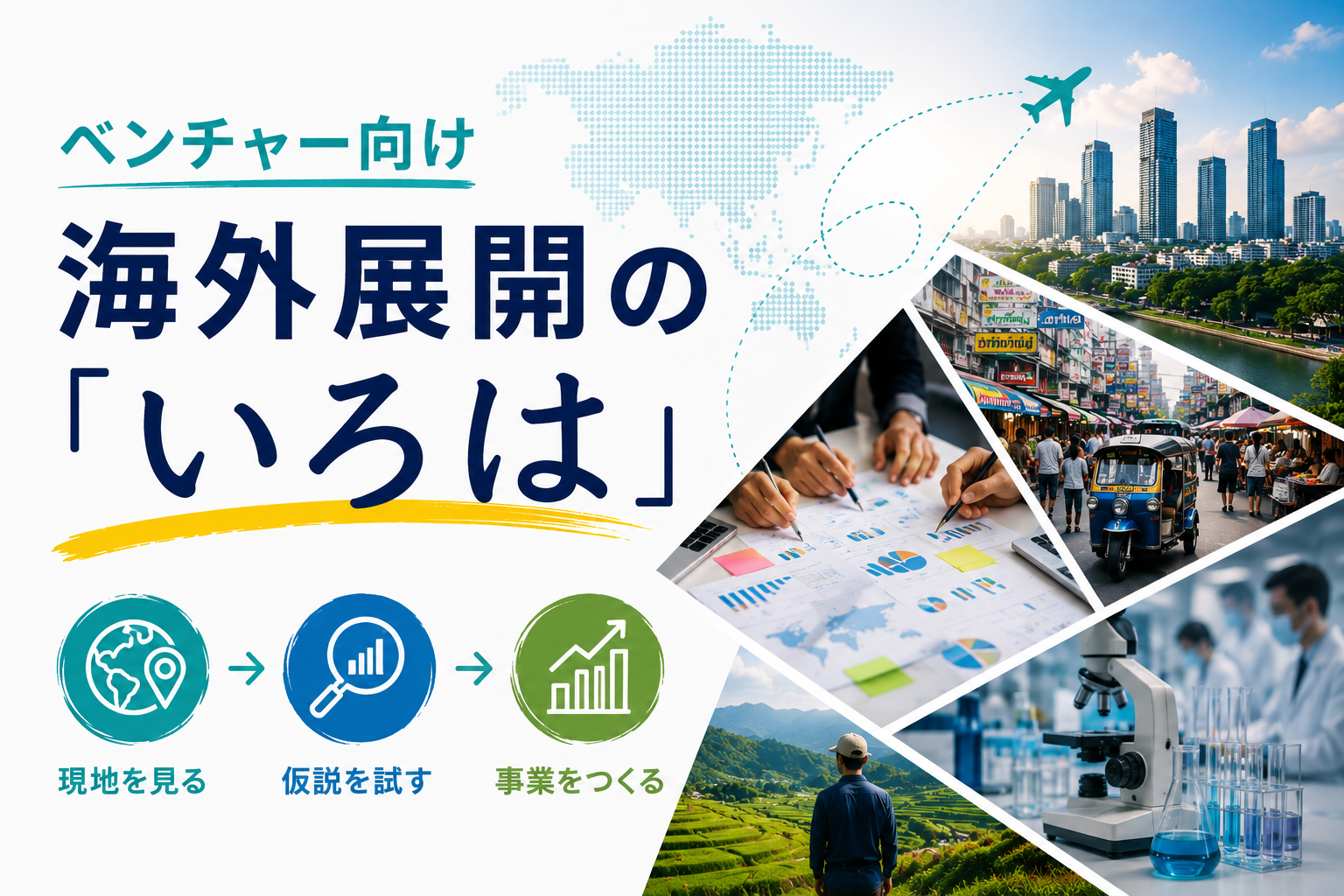
In this article, we will introduce three important aspects for venture companies to advance their overseas expansion: "seeing the local market," "testing hypotheses," and "creating a business."
I: See the site in person
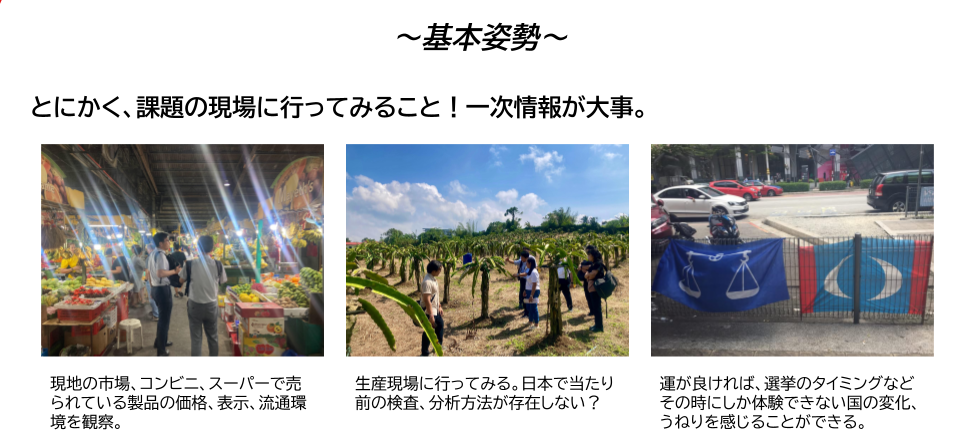
The first step in expanding overseas is toGo to the site of the issue and obtain initial informationIt is.
For food and food technology, try walking through the market or supermarket. See what prices the products are sold for, what labels are on them, and how they are distributed. For agriculture, go to the fields; for manufacturing, to the factories; for healthcare, to the hospitals.
Looking at the site in person can easily reveal assumptions that we take for granted in Japan.
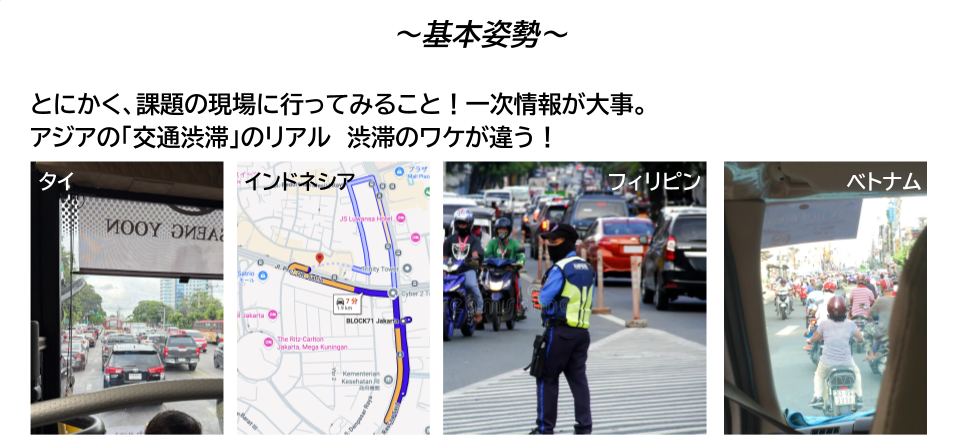
For example, when it comes to a single issue such as “traffic congestion,” the causes vary depending on the country. In countries with a high number of cars, countries with unique road structures, countries with issues in implementing traffic rules, and countries where motorcycles are currently the dominant mode of transportation but future economic growth is expected to see a surge in car usage. Even when using the same terminology, if you don’t actually go to the location, you won’t be able to see the underlying reasons.
That’s why it’s okay if the business plan isn’t completely finalized yet. On the contrary,It is only at this stage of speculation that it is worth seeing the site in person.It is the one.
Rō: Testing a hypothesis
Before going to the local area, we come up with hypotheses such as, "Maybe this product can be sold in this country," or "Maybe we can collaborate with this university."
However, when actually trying it out, that hypothesis may be incorrect. That is not a failure.
What is important in overseas expansion is not finding the right answer from the very beginning, butTry small hypotheses as quickly as possible and repeat hypothesis verificationIt is.
To do that, it is also important to meet with various people.
For government agencies, they should learn about the industrial policies and national strategies of the country and consider how their own technology can contribute to their implementation. For universities, they should explore the potential for collaborative research. For companies, they should visit companies that might seem like competitors at first glance.
Previously, when I visited Malaysia with a Japanese company developing waterborne drones, I arranged a meeting with the local underwater drone company. Although our fields are similar, when we actually talked, the technologies were complementary, and the relationship developed from there to the point where the local company showcased our products at an exhibition.
It's not that they don't meet because they're competitors,Just verifying what is the same and what is different becomes a hypothesis verification in itself.It is the one.
In Southeast Asia, the movement of talent is also very active. By valuing relationships not only with organizations but also with individual colleagues with similar interests, it is possible for that person to be transferred to another organization and lead to new collaborations.
Is: creating a business
After observing the local situation and testing the hypothesis, the next step is toTurning it into a businessIt's a stage.
Who is the customer? Who will pay the price? Will the product be manufactured in Japan or locally? Will the sales be handled in-house or through a local partner? Will the research be conducted through university collaboration or through a proof-of-concept (POC) initiative?
Overseas expansion is not simply about bringing products that are sold in Japan to other countries.Based on the primary information obtained locally, we assemble the “money flow” that determines who provides what, how, and where to generate revenue.It is.
And what we value most when traveling abroad is:The business card exchange doesn’t end there; you have to take the next step after you return home.It is.
There is no need to sign a major contract at the first meeting. It is important to concretize even one promise to move forward at that point, such as an NDA (non-disclosure agreement), a LOI (letter of intent), a MOU (memorandum of understanding), or a PoC (proof-of-concept).
To do that, preparation before traveling is indispensable. Bring assumptions with you, even if they are not complete—such as the agenda for the meeting, proposal materials, prototypes or samples, prices, and the period and conditions of the PoC (proof-of-concept). It is only by having prepared assumptions that you can have concrete discussions on the ground.
Behind this accumulation of efforts, concrete results such as Proof of Concept (POC), joint research, Letter of Intent (LOI), Memorandum of Understanding (MoU), and even the establishment of a local subsidiary will emerge.
Overseas expansion doesn’t start with creating a perfect plan.
See the local area.
Testing a hypothesis.
Creating business.
By repeating this cycle over and over again, we transform our vague overseas expansion plans into concrete business initiatives.
With the Global Bridge Program, we are bridging knowledge, technology, and human resources across countries and regions while working with companies to take the first step together.
It is okay if your business plan for overseas markets hasn't been finalized yet.
Why not start by going to the site where the problem exists?
