
Global Bridge Conference 2025 on Friday, December 12, 2026In this paper, Session 3.Making Japan the Center of Knowledge Manufacturing - Implementing the Inbound Globalization ConceptWe will send you a recap of the session on
The Japanese economy is facing declining population and calls for an end to deflation. New strategies are needed to overcome these difficulties and achieve sustainable growth. In this session, we focused on the creation of local industries and discussed "inbound globalization," which is not limited to attracting companies from outside the region, but also involves local companies taking advantage of innovative technologies possessed by overseas ventures to create new value. Local governments, medium-sized companies in charge of manufacturing, and the Financial Services Agency (FSA), which promotes national policies. The key persons in different positions passionately and openly discussed practical examples, the cultural gap they face in the field, and a roadmap for Japan to become a center where knowledge is gathered and new knowledge is created.
speaker
Mr. Yu Aoyama, Group Leader, International Liaison Team, Sales Strategy Department, Ibaraki Prefecture
Mr. Kazuya Inada, Specialist, Knowledge Manufacturing Department, KOBASHI ROBOTICS Co.
Mr. Seio Shimazaki, Counselor, Policy Bureau, Financial Services Agency
moderator
Shuhei Tsukada, Executive Officer, LIVERNESS Co.
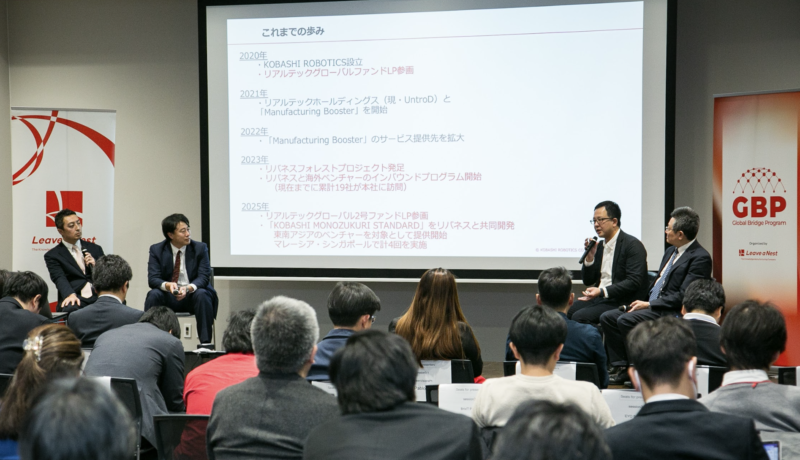
■From Attracting Overseas Companies to Capturing Knowledge: The Frontiers of Local Development
Shuhei Tsukada, Liberace: This is finally the last session. Those of you who have stayed this long are, in a sense, "brave" (laughs). Please stay with us until the end. My name is Tsukada of Liberace. I have a background in agriculture, and recently I have started a project in Toranomon to create a global nodal point under the theme of food tech, but basically I am a domestic person. However, I am convinced that this inbound globalization will be the core of our strategy in the theme we are setting forth today, "Making Japan the center of knowledge manufacturing. Combining knowledge with knowledge to create new knowledge. The act itself will become a "kigyo (industry). Japan has no resources, but "knowledge" is its only resource. How can we bring in knowledge from outside, pick it up inside, and turn it into an industry? Today, I would like to think about this from the perspective of each of the local government, companies, and the national government.
Before this session, there was a pitch from an overseas venture company that is trying to enter the Japanese market right now.
Financial Services Agency Seio ShimazakiI would like to thank all of the overseas companies that made presentations. It was very inspiring to see how they are trying to move society forward with their wonderful technology. I am now at the FSA, but I have known Mr. Tsukada and everyone at Rivanes for about 10 years, since I was transferred to Kumamoto Prefecture in 2015. At the time, I thought that even in rural areas, we should be able to do something that would be competitive with Tokyo. But in reality, all local governments were thinking only of "attracting big companies from outside. That in itself was not bad, but I wondered, "Is that all there is to it?" I wondered if that was enough. That's why I launched "Kumamoto Tech Planter" with Mr. Rivanes to nurture venture businesses from my hometown, Kumamoto.
mound rice field: Thank you very much. Kumamoto is now attracting a lot of attention because of TSMC's expansion, but today I would like to talk in depth about how to incorporate foreign knowledge into Japanese industry, rather than just "attracting" them.

Mr. Seio Shimazaki, Financial Services Agency
■"01 Support" of Ibaraki Prefecture and why the Vietnamese venture chose a local SME as its partner.
mound rice fieldWe have been working with Mr. Aoyama of Ibaraki Prefecture since last year on a project (FY2025 Business Matching Project with Promising Foreign Companies, etc.: https://lne.st/2025/06/02/ibaraki-6/) together with LIVANES. As we bring Southeast Asian ventures to Ibaraki Prefecture, we are not only trying to attract companies to Ibaraki, but also to create local industry. Just in October, a Vietnamese venture company, Alternō (https://lne.st/2025/11/07/vt-alterno/), established a base in Ibaraki Prefecture. What are your thoughts on this project, Mr. Aoyama? Please tell us what kind of issues you are aware of, along with an introduction to your business.
Ibaraki, Japan Yu AoyamaI am from Mito City, Ibaraki Prefecture, and I am a local prefectural government employee. However, although I am a prefectural government employee, I have spent much of my career in the national government, including a total of seven years working for the Ministry of Economy, Trade and Industry (METI) and the Ministry of Foreign Affairs (MOFA). Based on this experience in Japan, I am currently promoting international strategies from the perspective of revitalizing the local economy from a global perspective, or more specifically, how to incorporate the vitality of foreign countries into the region and, by extension, Japan as a whole.
Ibaraki Prefecture is geographically close to Tokyo, and from 2015 to 2024, the prefecture ranked first in the nation in terms of the area where factories are located, and has been number one in the nation for eight consecutive years in terms of the number of out-of-prefecture companies locating in the prefecture. As evidence of its favorable business environment, per capita prefectural income is also the third highest in Japan after Tokyo and Aichi, indicating not only potential, but also that it is reflected in the figures.
In this environment, our current focus is not simply on attracting large companies. We are focusing on "Zero Ichi," or how to help foreign companies take their first steps. We provide consistent support from the first step to the establishment of a base, including a support system for joint research with universities, research institutes, and companies in the prefecture, a start-up visa system for establishing a base, and subsidies. As a result, the collaboration between Alterno in Vietnam and Kikuchi Seiki, a local company, and the establishment of Alterno's base in Tsukuba City are steadily bearing fruit.
mound rice fieldThank you very much for your time. You mentioned that Alterno in Vietnam established a base with Kikuchi Seiki, a local so-called small and medium-sized enterprise, to "work together on manufacturing." In addition to the wonderful environment, what do you feel is the greatest potential of this base?
burial placeIn this context, we believe that there is a way to create new industries and further vitality by capturing the vitality of overseas companies and creating a win-win relationship with companies in the prefecture. In this context, we believe that the way to create new industries and further vitality is to capture the vitality of foreign countries and create win-win relationships with companies in the prefecture. In a society with a declining population, there is no future in extending the past. I believe that maintaining the status quo is a step backward.

Ibaraki, Japan Mr. Yu Aoyama
■The true strength of Japanese manufacturing lies in "highly reproducible manufacturing
mound rice fieldThank you very much. Now, let me ask Mr. Inada of KOBASHI ROBOTICS what actually happens in the field when an overseas venture company requests to work together on manufacturing. Kobashi Kogyo is an agricultural machinery manufacturer that has been in business for 100 years, but in recent years you have been focusing on supporting start-up manufacturing.
KOBASHI ROBOTICS Kazuya InadaYes, we are a medium-sized company in Okayama, and we are engaged in two businesses: the agricultural machinery business, which has been in operation for more than 100 years, and the manufacturing support business, which started about six years ago. In the manufacturing support business, we provide support for everything necessary in manufacturing, from design to mass production, and in the past 5 to 6 years, we have received many inquiries from 300 companies and support for more than 50 companies. In addition, from around 2020, we started full-fledged cooperation with overseas companies, and now we have over 20 companies from Southeast Asia visiting Okayama.
Also,KOBASHI MONOZUKURI STANDARDWe are also working with RIVERNESS to create an educational program that condenses 100 years of monozukuri knowledge and experience, and then we ourselves go overseas to directly communicate this knowledge to overseas ventures. We also go overseas ourselves to directly convey our knowledge to overseas ventures. One is that the challenges of manufacturing are the same in Japan and overseas, and that we all hit the same wall in the same places. The other is that the strength of the Japanese manufacturing industry is its ability to produce highly reproducible products.
This is referred to in terms of Japan quality or high quality, but it is not just about being able to make things, it is also about being able to complete drawings and documents well and with the same high precision no matter who makes them. This "know-how to improve reproducibility" is the knowledge that overseas ventures are seeking most. I think that inbound globalization, in which overseas ventures come to Japan to learn about this know-how and then go overseas again from there, is a good fit for the Japanese manufacturing industry.
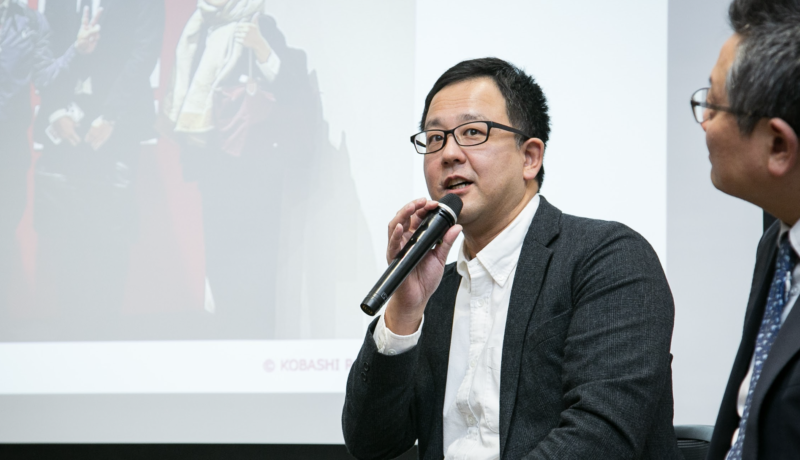
Mr. Kazuya Inada, KOBASHI ROBOTICS Co.
■Overcoming "cultural discrepancies" that occur at workplaces through "Matching".
mound rice field: When trying to manufacture with people from overseas, "Are these drawings acceptable?" and gaps in estimates are sometimes created. The more we try to fill in the gaps, the more they appear, and we end up stagnating there. How do you overcome this situation? Also, what kind of mindset is necessary for a manufacturing company to collaborate with an overseas company?
paddy fieldTo be honest, I think it is a very difficult problem, and the solution is not immediately obvious.
For example, even if I talk about the need for drawings, people who have never done this before will not understand, so I think there will inevitably be barriers. But we must not give up on that and talk with them over and over again to come to a common understanding of "what this document is needed for. This is also true for cooperation with domestic startups.
mound rice fieldSome people say that since we can't work with domestic startups, we can't work with foreign startups. However, we do not want to give up. It is important that they are attracted to Japanese manufacturing, and this ability to match is one of Japan's strengths. Mr. Shimazaki of the Financial Services Agency will now introduce the efforts being made by the government to accelerate this kind of movement.
island countryI would like to talk about "exit" beyond the collaboration between domestic and foreign companies. At TSE, there is a movement to properly support IPOs (initial public offering) as an exit for companies that come to Japan from overseas to conduct business. We have established a "Startup Hub" in collaboration with financial institutions and others to select and support startup companies in Asia. Asian companies will use Japan as a base to go public and further their global expansion. If Japan can become a "hub" for such companies, and if small and medium-sized enterprises can collaborate in this process, I believe this will lead to new business opportunities for Japanese companies.
To this end, if each municipality and financial institution has the idea of "completing the project only within their own prefecture," how do we create a meeting place that transcends regions and borders, without the need to have only that idea? I believe that a "bridge" mechanism such as the one that LIBANES is now trying to do will be one of the keywords to break through the stagnation.
More "Try It Out": Making Knowledge Manufacturing a New Strategy for Japan
mound rice field: Thank you very much. Finally, I would like to ask for your thoughts on how to overcome the barriers to make knowledge manufacturing a new strategy for Japan. Please start with Mr. Aoyama.
burial place: Yes, I do. I believe that walls are meant to be broken through. I agree with you all in concept, but it is important to actually take action on this point. Specifically, we need to work not only with Ibaraki Prefecture, but also with local financial institutions and related organizations in the prefecture in a truly organic way, and communicate with each other so that we are all facing the same direction. We also need to be involved in the matching process between foreign companies and local companies in Ibaraki Prefecture. We would like to be in a position to help match the companies where things are not going well.
mound rice fieldI think it's a good thing that we are all doing what we need to do. Let's all do what we need to do. Thank you very much. Now, I would like to ask Mr. Inada.
paddy fieldI think the most important thing is to increase the number of companies that are willing to give it a try. There are quite a few companies in the Japanese manufacturing industry that are willing to take on new challenges. When a medium-sized company provides manufacturing support to a start-up company, it becomes involved with a variety of companies and comes to understand its strengths. Strengths can only be known in relative terms, so unless you try first, you will never know.
Once those strengths are identified, they can be verbalized. When we are able to verbalize our strengths, we are able to gather a group of people and say, "We are strong in this area, so why don't we get someone else to do it? Instead of searching for someone on our own, more and more companies will come to us, and more and more collaborations will be born. I think this is just another way of saying, "Let's give it a try first.
mound rice field: In a way, if you move, the landscape will change. I think that by repeating this process, we will move in a better direction. Lastly, Mr. Shimazaki, please.
island countryI myself am not an individual business player, but I think it is very important that this idea of knowledge manufacturing be included in the thinking of people around the world. In other words, it is abstract, but it is about "spreading the idea as a good example. We need to transcend the barriers of position and ask, "What is that? and "How can we spread this?
mound rice fieldThank you very much. Exactly, once knowledge is gathered from the world to Japan, it is shaped together and goes out again. As a result, I believe that there is a worldview in which value is added and that this value is properly returned to the community. Finally, I would like to make one promise to all of you who are here. We have people coming from overseas. Please say a word to them. Each one of you being in a position to accept inbound visitors is the first step toward making knowledge manufacturing an industry in Japan. Thank you very much for speaking today.
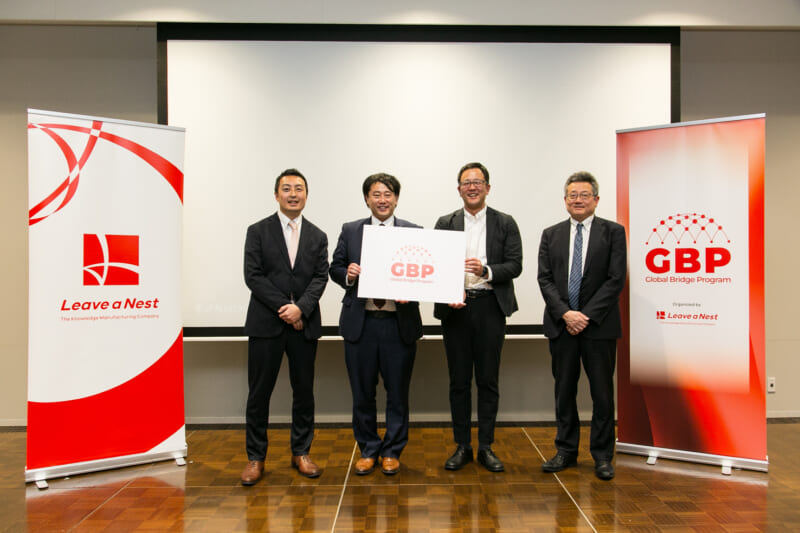
Ibaraki prefecture (Kantou area)
Group Leader, International Liaison Team, Sales Strategy Dept.
Mr. Yu Aoyama
He joined the Ibaraki Prefectural Government in 2007 and was seconded to the Ministry of Economy, Trade and Industry (METI) for 3 years from 2012, where he was in charge of designing and operating the system of subsidies for corporate location in the affected areas for the reconstruction from the Great East Japan Earthquake. After returning to the prefectural government in 2021, he will utilize his experience at the central ministries and overseas to work as a diplomat to revitalize the local economy from a global perspective. After returning to the prefectural government in 2021, he is currently promoting international business operations from a comprehensive standpoint, including planning of international strategies, acceleration of investment in Japan policy, and top sales promotion by the governor overseas, in order to revitalize the local economy from a global perspective.
KOBASHI ROBOTICS Co.
Specialist, Knowledge Manufacturing Dept.
Mr. Kazuya Inada
As an engineer at a domestic automobile manufacturer, he experienced catalyst development, embedded control development, and hybrid vehicle calibration work. Later, as a consultant at a domestic consulting company, experienced DX concept study, planning support, and development business process reform support for a major manufacturing company.
Financial Services Agency
Counselor, Policy Bureau
Mr. Seio Shimazaki
Counselor at the Financial Services Agency's Policy Planning and Promotion Department, serving as Director of the Planning and Promotion Department of Kumamoto Prefecture from 2014 to 2017, where he worked with Kumamoto University, Higo Bank, Kumamoto Industrial Association, and RIVANES to foster real tech startups. In particular, he launched the Kumamoto Tech Planter, the first of the "Regional Tech Planters" currently spread across 12 regions, with RIVANES in 2016. From 2017 to 2020, he served as Director of the Second Banking Division, Supervisory Bureau of the Financial Services Agency, where he was in charge of regional banking administration. He is currently in charge of the Innovation Promotion Office of the Financial Services Agency, which operates the FinTech Demonstration Lab and the AI Public-Private Forum.
LIVERNESS Corporation
Executive Officer
Shuhei Tsukada
D. in Applied Biotechnology, Graduate School of Agricultural and Life Sciences, The University of Tokyo. D. in Agriculture. Participated in the management of RIVERNESS since 2003, when the company was in its early stages of establishment. After accumulating practical experience in experimental classes and various types of writing, developed and introduced advanced technologies in the agri-field and launched a project to build an ecosystem for regional startups. He is committed to technology and business development in collaboration with major and medium-sized companies, venture companies, and researchers with a hands-on approach.
